Days at the Ruakura Farm

Driving along Ruakura Road between home in Eureka and work in the City of Hamiton, NZ. The Ruakura Research Centre has been changing from the 1900s. The name ‘Ruakura’ means “rua” – hole/pit and “kura” – red because in the early years before 1550, the cavity in the area that was used to burn iron oxide. Today it is becoming a new intergenerational development project creating a thriving business and lifestyle hub with logistics and port facilities. It is called the Ruakura Variation and owned around 822ha back in 2016, then they (Ruakura Variation appeal)  will rezone to 400ha in 2017. Not much happening except the new expressway motorway – NZTA Waikato Expressway will be completed in 2021. This expressway covering from Bombay Hills in the north down to Cambridge in the south and it is the longest – 102km with four lanes.

The place has a special memory of my early childhood with my grandparents during the school holidays. My grandfather worked at the Ruakura Research and the significant properties of the farms. His name was Alan Masters, and everyone at Ruakura Research Centre including farms called him, ‘Shorty”. Shorty was on the left while his old mate – Barry Hoskins was on the right at one of the largest farms – No. 2, which this farm was called.
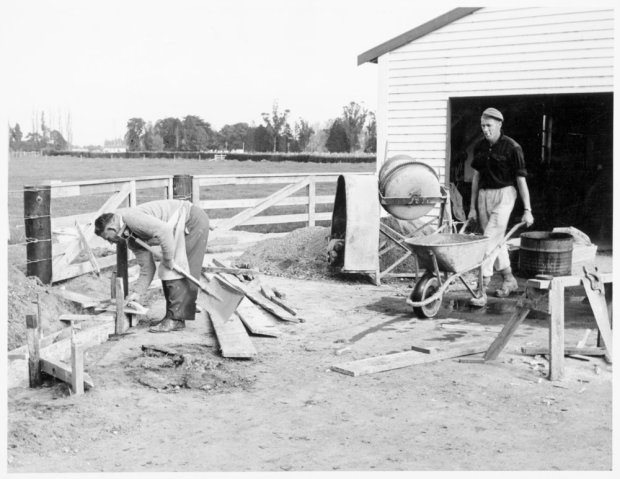
pr-7-0013.tif

Copyrights: AgResearch – Shorty and Barry.

So many names of the families worked there at the Ruakura Research Centre, I remember but there were too many names to mention. The most names I can remember were the Jury, Clayton, Gatenby, Umber, Lawler, Kimble? and Irwins.

One of the Watkinson families worked at the farms previous years before the Ruakaura AgResearch Station established in the early 1900s. It was John Watkinson and his wife, Rachel Watkinson nee Hall. They had got two daughters – Sarah and Ann, but Sarah died unexpectedly at the age of 38 years old. My late grandmother – Hilda was raised by John and Rachel because Hilda’s natural parents died suddenly. Hilda’s nicknamed as ‘Biddy’. I remember Ann over many years when Mama (Hilda) took me to see Ann and Tyrrel Brown and their only son – Trevor. Currently, Trevor and I kept regular touch every Christmas. I came across old photos from Hilda and my late father – Ray was only 1 year old and 1 month.

Let go back to John and Rachel Watkinson, they were living in Walton, in 1911 and it is a place at the junction of Walton Road and Morrinsville-Walton Road. This township is not far from our home in Eureka, and it is 34 km. John was a contractor in Walton and Ruakura Farming in 1911 then his family moved to a new home right in the middle of Ruakura Farm of Institutes from 1914 until he retired as a teamster in 1946 or before that year. Hilda met Alan at the dance club (but I may be wrong), and from there Alan landed himself a job working at the Ruakura until he retired. Alan – Shorty always takes me, my sister, two brothers to see the farms during the school holidays. I don’t recall that my sister and two of my brothers were regular visits or less because I was the most frequent visitors to the farms where Shorty worked, to shoot ducks as to cull the number of ducks, rabbits and possums at the farms, and other animals. I recalled there was a small project which wallaby there. Of course one of the fazed memories was alive

‘electric shock’ fence for I was not wearing a pair of gumboots and Shorty teased me for this. We do have another cousin from my mother’s side – John M. Follett (late scientist of  plants and foods Research including Myoga Ginger)

The Ruakura Research Institutes have expanded and changed the name to AgResearch Ltd (formerly known as New Zealand Pastoral Agriculture Research Institute Limited) from 1992.

Hooray for a Labour Weekend!

Samuel Parnell – Noted copyright.. https://nzhistory.govt.nz/media/photo/samuel-parnell

noted from NZ History – Samuel Parnell achieved fame as the founder of the eight-hour working day in New Zealand, a right he had fought for a carpenter at Petone in early 1840. Today his name is often linked with Labour Day, which has celebrated as a holiday since 1900.

Who is he? Where did he come from? Why is he doing this? What is his occupation?

A matter of the discovery in our mother’s father’s side family, his name was linked to my late grandfather’s ancestor. Wow, and I did not expect that. Whenever I do the genealogy and our family have hidden surprise or sad history, for example, one of our ancestor linked to Norman Kirk who he was a Prime Minister or John Follett whom he was researching in growing ginger in Waikato and the USA.

Samual Duncan Parnell born on February 19, 1810, and raised in London, England. He trained as carpenter’s apprentice until 1834 at joinery on Theobold’s Road in London. The Grand National Consolidated Trades Union formed in 1834 and carpenters worked long hours including Samuel. Samuel asked the union if they can support the shortening of the working day, but the union did not agree, and Samuel refused to join the union.
One day, Samuel met his first wife – Mary Ann Canham in 1839, and 11 days after they got married, they left for Wellington, New Zealand. Mary Ann was widowed when she met Samuel, and they bought a large property of the land in Wellington. One of their areas, it was Port Nicholson, later today it is a city of Wellington. The amount of their land was 40 ha of a country land plus 1-acre of the property as a Port Nicholson in the old days.

Before arriving in Wellington, Samuel met a shipping agent – George Hunter and Samuel said that the condition of working 8 hours per day is a must, no overtime. Hunter found it difficult, and later, he agreed with Samual. The quote that Samuel gave out “Eight hours’ labour, Eight hours’ recreation, Eight hours’ rest.” and this quote was from Robert Owen in 1817. Every day Samuel greet new migrants and told them to work 8 hours per day if anyone who has work overtime and anyone would be thrown into the harbour. That quote was the moment to everyone in 1841 and the 8 hours day cemented from 1841. 

Mary Ann died in 1842, and there were no children. Samuel sold the land in Hutt Valley and moved to Karoi where he runs an animal farm as a farmer in 1843. In 1851, Samuel met one of our ancestors – Sarah Sophia Brunger, another widow for she married Robert Brunger and had several children.

Samuel and Sarah returned to Wellington in 1873, and they lived in Cambridge Terrace, Wellington. Unfortunately, Sarah died in 1888 and Parnell have no natural children through Sarah while Sarah’s children came from James Brunger. Samuel died on December 17, 1890, and there was a significant public funeral three days after he died. There were a thousand of people respected Samuel and his idea – 8 hours per day.

Note: the first annual Labour Day was October 28 1890, and you can see the drawing below where many employers and merchants campaign to force the Government to restrict the working hours. Then the Labour Day Act 1899 established and became a statutory holiday. https://nzhistory.govt.nz/first-labour-day-celebrations

In our family – Sarah has got three children before married Samuel Parnell. One of her children was Elizabeth, who later married Robert Signal and they have a large number of children in Marton, Wanganui, New Zealand. Their eldest daughter – Agnes Signal married to my late great, great grandfather – Charles James Follett.

Facing new challenge each day!

When someone is facing bad news, a piece of good news, starting over again, a new challenge and the list go on.
Everyone is different, and their life could be similar such as learning to overcome the pain in their body, finding the strength of courage to face up their experience from darkness, trying to move on and start a new life.

Yesterday I went to the Waikato hospital for a couple of new Xray because of my body is changing from the past where I did lots of physical works such as doing the gardening, DIY, driving, walking and repairing the jobs. One funny thing and it does amuse me for I am a deaf person without a support person or my hearing partner. I arrived at the hospital early because of the car park, it was challenging to find a car park, and it has been difficult for other people to find a car park over many years. I went to the reception – the Radiology Department and I reminded the receptionist that I am deaf. They let me through into the waiting area. I waited and noticed the nurse walked around the corridor several times, looking for a patient plus calling out the name of the patient. It was only five minutes later, she came to me and asked me if I am the person who is Jean. My reply to this nurse, Yes, I am Jean for I am deaf. I was the only patient in the sub waiting area while the rest of the patients were in the CT waiting area on the other end of the room. The nurse was embarrassed, and she did read the note “Jean is deaf’ in highlight earlier but not sure if a Jean can lip read or looking at somewhere else. I was texting to someone and waited for the nurse to called out the name, but I could not see her face.

I ran into a friend from University along with staff/friends from the Hospital Department on my way out. We were chatting, and one of the team spoke to me by saying if I realise that I am a deaf bilingual rather a person with two or more than one languages. My reply was I often thought I could put down a deaf bilingual on any application form or not. Their response was to go for it. These staff and a friend encouraged me to go forward by putting down a deaf bilingual (with using the word deaf or not) from now to the future. It is called motivated to other people to do something they can do or to change the way they do in their life.

I stopped at the Punnet Cafe on my way home from the hospital for a lunch snack. I looked around people and families with young children, and they were either busy, restless, chatting away and trying to find a peaceful space in the room. I know it was noisy and I can feel vibrated where the children dropped and banging even crying loud. I noticed several people were looking at the young child who was screaming out loud and the mother of this child apologised. She spoke to me by saying sorry, and my reply was simple, I am deaf. The mother was astounded to my response.

Some days I visited many Deaf people, and they struggle to get through their daily life because they could not read formal letters from WINZ, GPs, Insurance company and to watch the breaking news by reading the captions on the television. Their first language is NZSL (New Zealand Sign Language) than any other language. Why there is no NZSL Interpreter on TV except the Parliament Channel? BUT not everyone watches the Parliament Channel every Tuesday and Thursday. For example, this week there was a fire outbreak in Auckland and the bulletin new popped up through social media BUT no caption or NZSL interpreters on TV. I received a text message via the National Civil Hazard app, which was great. The fire outbreak happened at the Auckland SkyCity Convention a couple of days ago. Many of the Deaf people were very disappointed for the lack of breaking news message because it was not getting through many Deaf people when they were working in the CBA or travelling to the CBA in Auckland. It is a massive challenging for these Deaf people to face into a dangerous area due to the lack of communication by other business, company and social media networks without using NZSL Interpreter available. Please consider thinking about how can you approach or send an emergency message to Deaf people even to add a new communication system by having an NZSL Interpreter in the social media and on TV. It is valuable input for the communication system and making Deaf people’s lives better where they are in the community. Better without using radio, a phone call, voice mail/message, face to face or watching any programme on tv without NZSL interpreter. Captioning is okay BUT their second language in English is not so great for them.