Purple Tuesday, an annual event, is a robust platform that champions accessibility and inclusivity for disabled consumers. This day, observed on the second Tuesday of November, not only serves as a reminder of the importance of making businesses and public spaces more accessible, but also significantly enhances their operations and customer base. It offers hope for a more inclusive future and encourages businesses to make their services more accessible, thereby increasing their customer base.
Related links
Key hashtags
- #PurpleTuesday
- #IAmYourCustomer
Did you know that 70% of disabled people will NOT return to a business after receiving poor customer service? This staggering statistic underscores the urgent need for companies to prioritise accessibility and inclusivity immediately. It’s not a problem we can afford to ignore or delay.
With 1.8 billion disabled people in the world, representing 17% of the population, the need for accessibility is a global issue that unites us all in a shared responsibility. It’s a cause that transcends borders and unites us around a common goal.
Removing barriers, such as ableism, across the infrastructure, improving signage in the Public Gardens, workplaces, and technologies. The lack of communication barriers, such as no interpreters for D/deaf people, D/deaf blind and D/deaf with disabilities and captioning on social media. It is not about financial funding to improve the quality of life, or about more accessible, friendly signage, or ‘visual’ signage such as flashing fire alarm, doorbell, or boarding time, which is expensive to make or adapt.
Let’s take a moment to reflect: are our services—businesses, the Health Sector, Airport services, and many others—accessible to everyone? Do they cater to the needs of all, including D/deaf people, D/deaf with disabilities and seniors with poor mobility/disabilities? For instance, businesses can install ramps and elevators, provide Braille signage, and offer online booking systems with accessibility features. These are just a few steps towards a more inclusive society.
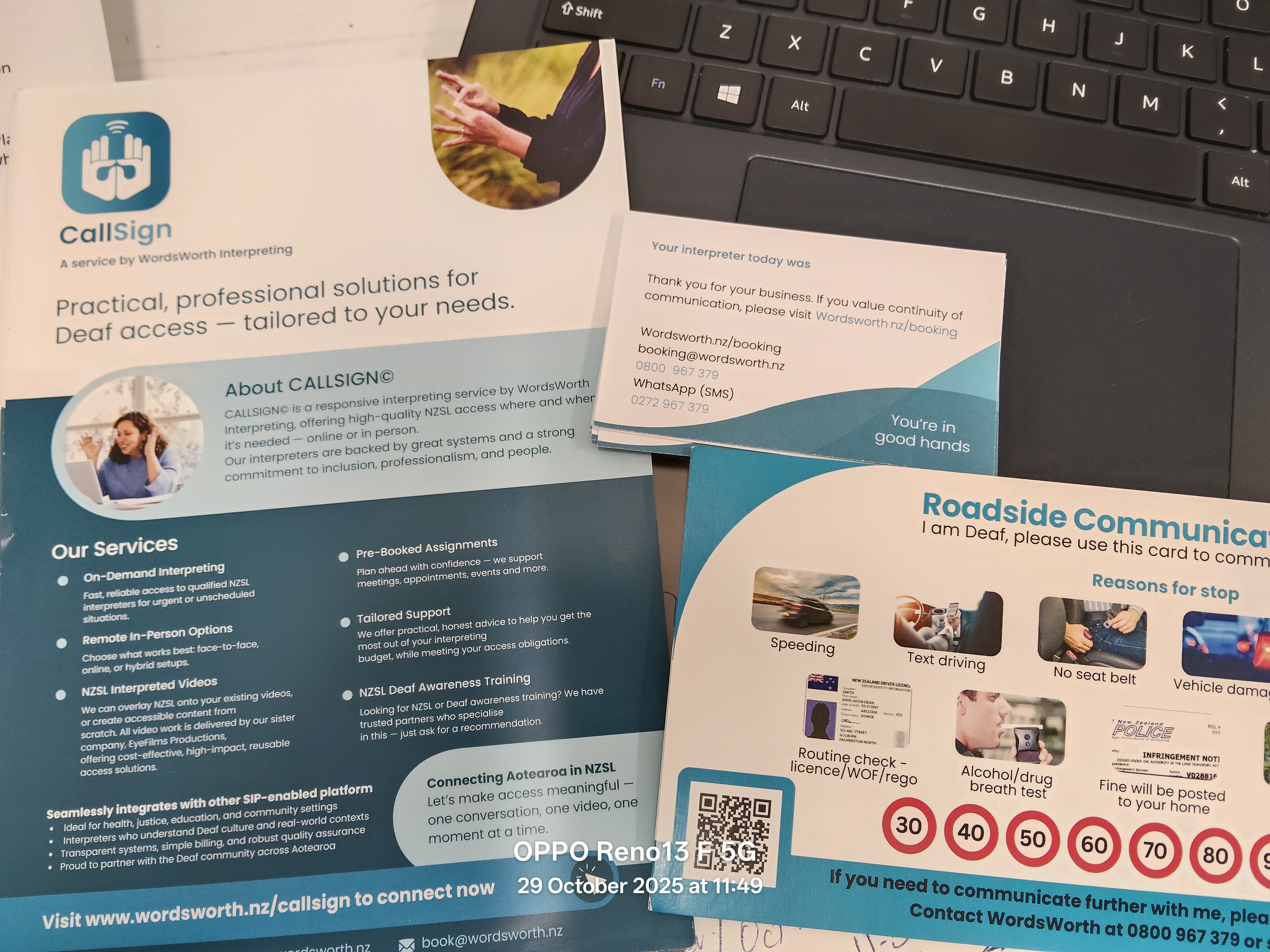
In Waikato, New Zealand, there is an updated additional service for Deaf People who need interpreter services from any business or Health Sector Service. Interpreter Services is Wordsworth Sign Language Interpreting, based in Hamilton. The system is called “CallSign”, a responsive interpreting service by Wordsworth Interpreting. This Interpretering Service wants to improve the quality of service for all people in the communities to reach many of their D/deaf clients and patients—this service benefits the health sectors, justice, education and community settings. There is an option for all Deaf Drivers when using a Roadside Communication Card. This Roadside Communication Card is beneficial for all Police Officers when stopping any Deaf Drivers. Inside the communication card are tips on various topics, such as speeding, texting while driving, and driving a red light as a reason for a stop. On the other side of the communication card, there are quick communication tips for Police Officers to understand our D/deaf needs of verbal commands. The card is similar to the USA and Vancouver cards, and here is the link—note it was four years ago. https://youtu.be/lLuzjS3HaYY?si=hE4jqJ4Rs5QjOBDj

Did you know about Universal Design for all people? Here is the link for you to look at or to read information – https://www.branz.co.nz/universal-design/
I suggest not ignoring this Universal design because you will be one of us at a stage of life you never know or expect, where there are health issues or you are involved in an accident.
https://www.nsai.ie/standards/sectors/universal-design-and-inclusion/
https://universaldesign.ie/about-universal-design/the-7-principles
This universal design link is from New Zealand, and it is weak. This link provides guidelines for anyone who does housing, office buildings, and/or school buildings. We, people with disabilities, advocate that this guideline should be placed under the Law and Regulations Act through the Parliament here. We do not want to hear about the financial cost of building the building by the contractors, the architects, or the Council’s decision-making on the Building consents. https://www.gpg.govt.nz/workplace-design/universal-design-approach/
Here is another link from the Building Performance website: Complying with the Building Code. The Building Code is contained in regulations under the Building Act 2004.
For example, look at Kāinga Ora and the housing across Aotearoa-New Zealand, which does not meet the needs of thousands of people with disabilities and seniors with poor mobility/disabilities to live in and make their lives better quality in the communities. There are 851,000 people (17 per cent) in households in Aotearoa/New Zealand who are disabled. Extract from AI – There is no single global figure for the number of disabled people living without a home. The number varies significantly by country, and data on disability and homelessness are often incomplete or inconsistent. However, data from New Zealand can provide a detailed example of the disparity disabled people face in housing.
In New Zealand:
- Higher rates of severe housing deprivation: The 2023 Census found that disabled people were more than twice as likely as non-disabled people to experience severe housing deprivation. For every 10,000 disabled people aged five and over, 414.5 were severely housing-deprived, compared to 203.7 per 10,000 non-disabled people.
- Increased risks across all categories: The disparity holds across types of housing deprivation, including living without shelter, in uninhabitable housing, or in temporary accommodations.
- Specific issues with inaccessible housing: Beyond homelessness, a significant problem is a lack of accessible and affordable housing. A 2022 survey found that as few as 2% of homes for sale in New Zealand were accessible to people with disabilities.
Factors that contribute to homelessness among disabled people include:
- Income inequality: Disabled people often have lower incomes, making it harder to afford housing.
- Discrimination: Many disabled people face discrimination in the housing market and are denied rental applications.
- Accessibility challenges: The lack of accessible homes forces many to live in unsuitable conditions or without housing.
The search results for this query focus exclusively on New Zealand. However, the data highlights a broader global problem, as disabled people worldwide are more likely to experience housing insecurity and poverty.
It is not about a bad example; it is the main problem of a lack of awareness, and their response costs too much money to repair or adapt for people with disabilities/seniors with mobility/issues. Honestly, tenants pay rent to them. There is not enough accessible housing for people with disabilities/seniors with disabilities; for example, one accessible house vs four fully accessible houses are not accessible—what is Kāinga Ora’s problem?
Have you considered our neighbour islands—the Pacific Islands? Extract from AI – There is no single, precise figure for the number of deaf people across all Pacific islands, but they constitute a significant portion of the population. Estimates suggest that over one in ten people in the Pacific region live with a disability, many of whom are deaf or hard of hearing. In the Western Pacific, the World Health Organisation (WHO) reports over 546 million people with hearing loss, and a local estimate suggests about 1.5 million people with disabilities live across the Pacific Island countries and territories, which includes those with hearing impairments.
Pacific Region: Over one in ten people live with a disability, many of whom are deaf or hard of hearing.
Western Pacific: The World Health Organisation (WHO) estimates more than 546 million people live with hearing loss in this region.
Pacific Island Countries: An estimate from the Pacific Disability Forum suggests that about 1.5 million people with disabilities live in the Pacific Island countries and territories, which includes the deaf and hard-of-hearing population.
Extract from the RNZ in 2012. https://www.rnz.co.nz/international/pacific-news/206244/deaf-people-the-most-neglected-of-solomon-islands’-disabled
from the Guardian Newspaper – 2022
From Australian Media 2024
https://www.abc.net.au/pacific/what-is-it-like-growing-up-deaf-in-solomon-islands-/104563884
There are six core partners: Australian Aid, New Zealand Foreign Affairs and Trade, CBM (I know this one —we keep in touch), Centre for Inclusive Policy, United Nations, and International Disability Alliances.
 Life in Eureka
You must be logged in to post a comment.