Ratapu 21 o Oketopa 2025, as in Māori (Sunday, October 21 2025)

Ratapu 21 o Oketopa 2025, as in Māori (Sunday, October 21 2025), we come together to celebrate the strength that comes from unity —a bond that connects us all, showcasing the unity and stability that is inherent in Māori culture.

He kai kei aku ringa

There is food at the end of my hands

Said by a person who can use their basic abilities and resources to create success.

“Ēhara tāku toa i te toa takatahi, engari he toa takitini.” 

Translation: My strength is not from one person, but from many. Meaning: We are stronger when we work together; strength comes from unity. 

Māori songs, a vibrant part of community events, find their fullest expression through kapa haka, concerts, Marae, welcome, blessing, and many other performances. Kapa haka, a traditional Māori performing art form from New Zealand, is a powerful means of cultural expression, combining song, dance, and chanting to convey the depth of Māori identity and history. The name itself, ‘to form a line’ and ‘to dance’, hints at the emotional and cultural significance of this art. Kapa haka includes various elements such as powerful haka (war dances), graceful action songs (waiata-ā-ringa), and choral singing, often featuring rhythmic movements like foot-stamping, body slapping, and tongue protrusions. These performances, rich with emotional depth and the beauty of Māori culture, are a vital way for Māori people to showcase their cultural heritage and are practised in schools, communities, and at major events like the Te Matatini competition. The beauty and emotional depth of these performances will surely leave you feeling connected and appreciative of the Māori culture.

Several songs are available in NZSL with Māori concepts, and this is just the beginning for them to learn more about their background and culture. For example, a Pepeha is not just a set of words; it’s a powerful tool that connects us to our Iwi (Tribe), Manga (ancestral mountain), awa (river), hapū (sub-tribe), and meeting place (Marae), reminding us of our rich Māori heritage. The educational value of the Māori language and concepts will surely leave you feeling informed and enlightened. 

The song, which Te Aroha in NZSL Te Reo concepts sang, is now available for everyone, including Taangata Turi Maaori.

Today, we have the new Māori Kuini (Queen) – the youngest of the siblings and their father, Kiingi Tūheitia (full name Tūheitia Pōtatau Te Wherowhero VII), who passed away on August 30, 2024.

Nga wai hono i te po Pōtatau Te Wherowhero VIII (Nga wai hono i te po Paki) is the youngest daughter of Tūheitia. She is a direct descendant of the first Māori king, Pōtatau Te Wherowhero, who was installed in 1858. Nga wai hono i te po’s first language is Te Reo Māori, and she is deeply immersed in Māori culture and traditions from an early age. She loves Kapa haka, having taught it in her second year at the University of Waikato. There is a bit of history behind her name’s meaning, as told to her by her grandmother, Te Arikinui Dame Te Atairangikaahu, the only previous Māori Kuini (queen).

Te Atairangikaahu was on the annual Tira Hoe Waka canoe journey down the Whanganui River and had stopped for the night at Parikino Marae when she heard that her granddaughter had been born. She asked Whanganui kuia Julie Ranginui for a name for the baby, and together they settled on “Nga wai hono i te po ” (meaning “the waters joining in the night”), referring to the meeting of the Waikato River people with the Whanganui River people that night.

@petervaneeden3651, a place to stand makes sense; everyone should have that right over their affairs. Tūrangawaewae is one of the most famous and influential Māori concepts. It means foundation, foot, and translates as ‘place to stand’. Tūrangawaewae are the places where we are strong and connected. They are our foundation, our place in the world, our home.he waahi e tu ai Ko Tūrangawaewae tētahi o ngā ariā Māori rongonui, tino kaha. Ko te tikanga ko te turanga, ko te waewae, ka whakamaoritia he ‘wahi hei tu’. Ko Tūrangawaewae nga waahi e kaha ai tatou, e hono ana. Ko ratou to tatou turanga, to tatou waahi ki te ao, to tatou kainga.

There was a waiata (song) I recall by one of the lecturers at the University of Waikato, Hirini Melbourne. Hirini Melbourne was from the Tuhoe and Ngati Kahungunu tribes. From 1978, he was on the staff of the University of Waikato, becoming an Associate Professor and Dean of the School of Māori and Pacific Development. Hirini developed them into a song of remembrance for one of his students who had died after facing numerous adversities. In 2002, Melbourne was awarded an Honorary Doctorate from the University of Waikato. He was appointed an Officer of the New Zealand Order of Merit in the 2003 New Year Honours, for services to Māori language, music and culture, just before his death a week later.

Today, there are a couple of waiata along with NZSL Te Reo Māori concepts.

Rāhoroi 20 o Hepetema (Saturday, September 20)

The 1975 Māori Land March, a pivotal moment in Aotearoa’s history, was a testament to the indomitable spirit and leadership of the legendary Dame Whina Cooper.

Hōhepine (Josephine) Te Wake was her real name when she was younger and living in the Northland, Aotearoa.

Whina Cooper, URL: https://nzhistory.govt.nz/people/dame-whina-cooper, (Manatū Taonga — Ministry for Culture and Heritage), updated 27-Oct-2021

As an eleven-year-old student at Hamilton West School, Kirikiriroa (Hamilton), I was deeply moved by the Hīkoi Land March to Parliament, Te Whanganui-a-Tara (Wellington), which I watched on our black-and-white television at home. My mother’s attempts to explain the significance of the land protest and the longest walk from Te Hāpua in the Northland left a lasting impression on me. This personal connection to Dame Whina and the Land March – Hīkoi, which was further deepened during my studies at the University of Waikato in the mid-1990s, where I delved into the history of the Māori Land March through the works of Professor Michael King, who wrote a book about Dame Whina Cooper, made the experience even more profound.

Note – the name of Wellington: Wellington has both Te Whanganui-a-Tara and Pōneke as Māori names, but they have different origins and uses. Te Whanganui-a-Tara means “the great harbour of Tara” and refers to the harbour and surrounding area, while Pōneke is a phonetic transliteration of the European name Port Nicholson. Both are now used to refer to the city and are often used interchangeably, though Te Whanganui-a-Tara is rooted in indigenous history. 

One of the Deaf Seniors in Waikato was telling me about his recall of the Land March and a couple of confusing surrounding issues with his whaea’s (Mother’s) connection to Princess Te Puea Hērangi, late Māori Queen Te Atairangikaahu and Dame Whina Cooper in the photographs. His niece has no idea as well, and they asked another senior whanua. Yes, turi kaumatua (the Māori Deaf seniors)’ whaea (mother) had been involved with the Iwi-Tainui, where their ancestors were linked to Hauraki and Ngāpuhi. The turi kaumatua (Māori Deaf senior)’s whaea and her group established the new Hui Te Rangiora Marae, along with Catholic New Zealand. The meeting house at Hui Te Rangiora Marae in Clarence St, known as Tu Waerae, was opened in November 1974 by the first Māori Queen, Te Atairangikaahu.

Hui Te Rangiora, the renowned Polynesian navigator, is a significant figure in Māori history, representing the spirit of exploration and navigation. His image is carved on the Turangapeke meeting house at Te Awhina Marae in Motueka, a testament to his enduring legacy and the respect he commands in Māori culture. This connection to Hui Te Rangiora allows us to feel a part of Māori history and culture, fostering a sense of connection and respect for his enduring legacy. 

Hui Te Rangiora was such a great voyager that there is a whakataukī (proverb) about him: Tāwhana kahukura runga, ko Hui Te Rangiora te moana i tere ai. When the curved rainbow is seen above, Hui Te Rangiora glides swiftly below.

Rāhiri is the founding ancestor of Ngāpuhi. Born at Whiria pā, he was the son of Tauramoko and Te Hauangiangi. Tauramoko was a descendant of two captains – Kupe of the Matawhaorua canoe, and Nukutawhiti of the Ngātokimatawhaorua canoe. Te Hauangiangi was the daughter of Puhi, captain of the Mataatua canoe.

Let’s continue about the Landmarks, and there was another landmark, which was the Takaparawhau/Bastion Points, at Ōrākei, Auckland. The area is significant in New Zealand history as the site of protests in the late 1970s by Māori against forced land alienation by Pākehā (European settlers). Before European settlements, the land was occupied by Ngāti Whātua Ōrākei.

https://nzhistory.govt.nz/media/video/reclaiming-bastion-point-roadside-stories

https://e-tangata.co.nz/history/bastion-point-a-desperate-struggle-and-a-dream-fulfilled/https://e-tangata.co.nz/history/bastion-point-a-desperate-struggle-and-a-dream-fulfilled/: Rāhoroi 20 o Hepetema (Saturday, September 20)

The Māori protest movement is a centuries-long fight for indigenous rights, gaining significant momentum in the 1970s, with a focus on the Treaty of Waitangi, Māori land rights, language, and culture. Key protests include the 1975 hīkoi (land march), the Bastion Point and Ihumātao occupations, and recent nationwide hīkoi opposing policies seen as undermining Māori rights and the Treaty of Waitangi. This ongoing struggle underscores the urgency and importance of the Māori land rights movement. 

Europeans did not own the land when they arrived in Aotearoa until the Māori Land Wars. Māori gave a bit of the land to settlers, such as Traders and whalers, who married the sons/daughters of the hapu and other ways of living on the land and before European settlement, Māori had no concept of selling land, and few chiefs had the mana (authority) to tuku (gift) it.  Before the arrival of European settlers, Māori had collective kaitiakitanga for the whenua in their territory. No one person had ownership rights – everyone worked together to make the most of the whenua while ensuring its protection and sustainability for the future.

Europeans acquired Māori land primarily through purchases of land under the Treaty of Waitangi, which granted the Crown the exclusive right to buy land from Māori. European demand for land was high, and the Crown would then resell it to settlers. However, this process was often marked by dubious tactics, such as purchasing from individuals instead of groups, withholding promised reserves, and pressuring Māori into sales.  The Māori Land Wars, officially known as the New Zealand Wars, were a series of conflicts in the mid-19th century (roughly 1840s to 1870s) in the North Island of New Zealand, primarily over land and sovereignty issues following the signing of the Treaty of Waitangi. These wars were a result of Māori resistance to the loss of their land and the encroachment of European settlers. They culminated in widespread land confiscation from Māori and significant loss of life, mostly among Māori. 

https://www.tepapa.govt.nz/discover-collections/read-watch-play/maori/treaty-waitangi/treaty-close/full-text-te-tiriti-o

E rua ngā tauira o Te Tiriti o Waitangi. Ko te reo Māori, me te reo Pākehā. Rapua ngā kōrero mō te whakamāoritanga o Te Tiriti, ngā kōrero o roto me ngā rerekētanga i tētahi ki tētahi..

Understanding the Te Tiriti o Waitangi (Treaty of Waitangi) is crucial to grasping the historical and cultural context of New Zealand. There are two versions of the Treaty, one in te reo Māori and one in English. Exploring how the translation occurred, what each version states, and how they differ in meaning is a crucial step in understanding the Treaty’s implications. This understanding is not just informative, but also engages us in the ongoing discourse about indigenous rights in New Zealand.

https://www.archives.govt.nz/discover-our-stories/the-treaty-of-waitangi/what-te-tiriti-o-waitangi-says-in-english-and-te-reo-maori

There was a fourth article of the Te Tiriti o Waitangi  –  “fourth article” is a widely discussed concept referring to a verbal agreement for the protection of religious freedom that arose from an exchange between Bishop Jean Baptiste Pompallier and the Crown at the signing on February 6, 1840. This agreement was not inscribed on the formal Treaty document but is a significant part of its historical and cultural context, particularly for Indigenous Māori. 

There isn’t a single definitive list of Te Tiriti o Waitangi principles, as they have been developed through case law by the Waitangi Tribunal and the courts over time, but generally encompass Partnership, Protection, Participation, and Kāwanatanga. These principles outline the Crown’s duty to govern while also protecting Māori interests, ensuring Māori have a say in decisions, and fostering a relationship of cooperation between Māori and the Crown to achieve fairness and equitable outcomes. 

Core Principles of Te Tiriti o Waitangi

  • Partnership: Acknowledges that the Treaty created a relationship between Māori and the Crown, requiring both to act in a strong, enduring, and cooperative relationship, with good faith and mutual respect. 
  • Participation: Ensures that Māori have the opportunity to provide input into decision-making processes at all levels, recognising their rights and responsibilities. 
  • Protection (Active Protection): The Crown must actively protect Māori interests, rights, taonga (treasures), and rangatiratanga (authority or self-governance). 
  • Kāwanatanga: Recognises the Crown’s right to govern Aotearoa New Zealand, a right that is balanced by the need to respect Māori self-determination. 

Other Key Principles and Concepts

  • Tino Rangatiratanga: The right for Māori to self-determination, self-management, and authority over their own resources and affairs. 
  • Equity: The Crown’s obligation to ensure that Māori achieve equitable social and health outcomes, addressing imbalances and providing options for culturally appropriate services. 
  • Redress: The Crown’s responsibility to provide processes for the resolution of grievances arising from breaches of the Treaty. 

The New Zealand Parliament and all Political parties do not recognise Article Four.

Paraire 19 o Hepetema (Friday 19th September)

“Kāore he mutunga o tēnei mea, te ako” — “There is no such thing as an ending to learning.”

Te Reo Māori, with its profound beauty and depth, is a challenge to capture in this blog fully. It’s not just a language, but a rich tapestry of culture and history that we’re only just beginning to unravel. From its meanings and pronunciations to its myths, performances and songs, it’s a journey of discovery that inspires and intrigues, inviting us to delve deeper into its intricacies and marvel at its beauty.

Symbolises the resilience, adaptability, and enduring nature of te reo Māori. It’s a call to action, highlighting the ongoing commitment to its preservation and growth for future generations. It’s a responsibility we all share, a connection that binds us to the past and future of our language and culture, and a reminder of the importance of our collective efforts in this journey. 

A brief article about our tanagata Turi – John T. Rua (Ngāi Tūhoe), a Deaf Tohunga Whakairo (Master Carver).

Ngāi Tūhoe Tohunga Whakairo (Master Carver) John T Rua, dating from 1980. John has an impressive whakapapa, being the grandson of the revered Māori Prophet Rua Kēnana, and is considered a master and cultural leader in his gift of whakairo artwork, a literal ‘living treasure’ in Aotearoa. Becoming deaf at a young age led him to eventually study whakairo under the tutelage of fellow Tohunga Whakairo Hone Te Kauru Taiapa (of Ngāti Porou) and graduate with honours from the prestigious New Zealand Māori Arts and Crafts Institute in 1972 (where Hone had been appointed its first master carver in 1966). From here, John continued to develop an impressive body of work, carving thousands of individual pieces as well as working on many marae and other buildings of national significance. In 1992, the Māori community recognised his service to Aotearoa with the presentation of The Queen’s Medal. John’s work is held in private and public collections globally. Today, he lives in the Bay of Plenty area, continuing to teach whakairo as well as sign language throughout the region.

https://www.gumtree.com.au/web/listing/collectables/1315192240

A brief history about his grandfather – Rua Kēnana Hepetipa https://nzhistory.govt.nz/keyword/rua-kenana

There is another interesting Maaori tangata haua – te kaiwhakamahi tuuru wira (Maaori disabled – wheelchair user). This person is inspiring and energetic, having come home from the USA; however, he is Māori. His name is Rodney Bell, and he descends from the Ngāti Maniapoto tribe. Rodney acquired a disability as a result of a motorcycle accident as a young adult below the chest. His artistic expression demonstrates elements of traditional Māori culture, yet at the same time, he’s continually seeking new ways to enhance his creative process. https://youtu.be/tkb6eB7yAZ4?si=ineg1yfwDog9JQw6

https://youtu.be/cp9U1laiA_0?si=JUMGXM0OH5JY9PE8

Let’s move on and look at the new Māori kupu (word) in the Disability world.

Let’s explore the relationship between Te Reo Māori and Autism. One of the well-known terms is Takiwaatanga for Autism, which means ‘in my/their/his/her own time and space.’ This word reflects the Māori language’s approach to neurodiversity, emphasising the importance of allowing individuals to operate in their own unique time and space, respecting their individuality and pace of life.

Takiwaatanga is a mana-enhancing term that regards autistic people as taonga, unique individuals with gifts and strengths. Keri Opai coined the term after consultation with taangata whenua (Māori people) and taangata whaitakiwaatanga (Autistic people). It’s a celebration of diversity and a reminder of the unique contributions each individual makes to our society.

Hauātanga/whaikaha (both words are nouns) – Disability

hauāuki – (noun) permanent disability

Māori is actually not one language, and there is not really one Māori people, but many tribes (Iwi) and many different dialects and variations in the language. https://contentcatnip.com/2021/09/20/a-collection-of-maori-proverbs/

A well-known Māori proverb about perseverance is “Whāia te iti kahurangi, ki te tūohu koe, me he maunga teitei,” which translates to “Seek the treasure you value most dearly, but if you must bow your head, let it be to a lofty mountain”. 

This saying encourages people to aim high, pursue their goals with great effort and resilience, and only to give in when faced with a truly formidable obstacle, symbolising perseverance and tenacity. 

Karekau he arai mo te hunga haua Maori katoa ki te uru atu ki nga mahi whakaari, kapa haka me etahi atu mahi puta noa i Aotearoa. Ka taea e ratou te mahi i nga mea katoa hei whakaatu i te riterite o o tatou hapori.

In English – There are no barriers for all Māori disabled people to participate in performances, kapa haka, and other activities across New Zealand. They can do anything to demonstrate our communities’ equality.

Thursday, October 18, known as Taite 18 o Oketopa

Thursday, October 18, known as Taite 18 o Oketopa in Māori, we come together to celebrate the strength that comes from unity —a bond that connects us all.

“Ēhara tāku toa i te toa takatahi, engari he toa takitini.” 

Translation: My strength is not from one person, but from many. Meaning: We are stronger when we work together; strength comes from unity. 

Stephanie Awheto

Ngaati Ruanui Taranaki

Iwi – Ngaa Ruahine

Haapu – Tamaahuroa titahi

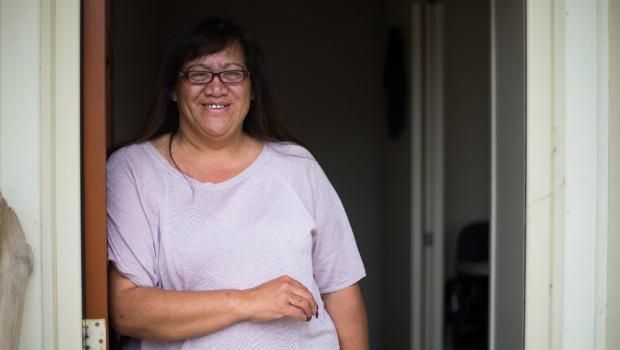
Ko ngā hui pēnei i ēnei ngā wā kia tangi ki ngā mate. Gatherings like these are the times for remembering the dead. Stephanie – te kaiwhakamaori reo toru tuatahi mo te Tāngata turi i Aotearoa. (In English, Stephanie was the pioneering first trilingual interpreter for the Tāngata turi in New Zealand, a role of immense significance and impact.)

I was reflecting on the past when I first met her in Hamilton in the late 1980s and 1990s. A brief History of the Deaf Community in Hamilton: Back in the 1980s and 1990s, there was no Deaf service or organisation for the Deaf community and no interpreter for the D/deaf people/Tāngata (Māori Deaf people) when I was a BNZ Data Entry Officer. At Melville Intermediate School, the late Patrick W. Thompson was my classmate in the Deaf Units in the late 1970s. My sister studied in a Māori course and other classes at the Waikato Teacher College. Then, my mother learnt to study in a Māori course at Waikato University.

Patrick’s curiosity about his Māori background and Te Reo Māori at school led him to seek Stephanie’s help. Her unwavering dedication to helping him reconnect with his roots is a shining example of her commitment to the Deaf and Māori communities. This connection blossomed into a warm relationship, with Stephanie welcoming Patrick into her whānau over many years until his passing in 2014.

Stephanie completed her Interpreter course at AUT in 1996, and she and her young whānau moved to Hamilton in the early 1990s. The Deaf Association of NZ: Hamilton Branch (later changed to Deaf Aotearoa) opened in Hamilton in 1991.

No official languages existed for the D/deaf people and Tāngata Turi (Māori Deaf people) in Aotearoa until 2006. In 1987, Te reo Māori was made an official language, followed by NZSL (New Zealand Sign Language in 2006. The main problem was where the Te reo language is, as in sign language for the Tāngata Turi (Māori Deaf people). As you see, there was never an original sign language by the Tāngata Turi (Māori Deaf people) for over a hundred years. Proto-Polynesian, a language spoken about 2,000 years ago, is the ancestor of all Polynesian languages. Māori people arrived in Aotearoa a thousand years ago, and their language was Te Reo. Then, the English settlers/immigrants came to Aotearoa with their English-speaking language, but there were several minor languages spoken, such as Dutch, Norwegian, Danish, and even Polish. In 1867, the Government and Education banned all Māori children from speaking te reo in schools.

How does sign language come here? Who was/were the people who used sign language here? It is the D/deaf people themselves who brought sign language back as ‘loan sign language’ to Aotearoa/New Zealand from the boarding schools in Australia, the United Kingdom and the USA. They created sign language like Pidgin-Creole sign language when encountering other D/deaf people in different districts, businesses/trade around Aotearoa. NZSL is more or less closely related to AUSLAN (Australian Sign Language) than BSL (British Sign Language). We need to have actual records of Pidgin-Creole sign language here while linguists continue researching and understanding the past. Sign language was banned through schooling at Van Asch, Titirangi School for the Deaf, Kelston School for the Deaf and in different regions of the North Island Deaf Unit Schools in the past due to the Second International Congress on Education of the Deaf, an international conference of deaf educators held in Milan, Italy, in 1880. Today, it is known as the Milan Conference or Milan Congress to many D/deaf people worldwide.

Stephanie interpreted my paper course at Waikato Polytechnic, where I earned a certificate in Human Service: People with Disabilities.

Fast-forward: Stephanie was talking to Patrick by learning sign language. She was confused by one or more sign languages translated in English to Te reo—hang (in Sign Language as a hand grasped in front of the neck) vs. hangi (cooking foods on top of the heated rocks in the buried pit) in Te Reo without sign language. Patrick described what he was trying to explain from his sign language to Te Reo. Many of the D/deaf people who sign for ‘hang(i) were exploited or offended by any Tāngata Māori around Aotearoa.  

He waka eke noa

A canoe which we are all in, with no exception

Stephanie’s decision to become a trilingual interpreter for the Tāngata turi Māori was a significant step towards bridging cultures. Since Te Reo became an official language in 1987, there has been no trilingual interpreter for Tāngata turi Māori. The gap was particularly felt during critical cultural events such as the marae ātea, hui, and the significant landmark of the Te Tiriti o Waitangi. Stephanie’s role as a bridge between cultures not only facilitated communication but also fostered a deeper understanding and respect for the Māori Deaf community.

Ko taku reo taku ohooho, ko taku reo taku mapihi mauria

My language is my awakening, my language is the window to my soul.

Stephanie travelled around Aotearoa as a trilingual interpreter in hui, the marae ātea, Māori Deaf development activities at the marae ātea, and at the university where I took my BA in Arts and Stephanie mentored trilingual Māori interpreters/Te Reo Rotarota Māori interpreters. Stephanie was there to interpreted when I received my BA degree at the University of Waikato – the

Te Kohinga Mārama Marae

Te Kohinga Mārama Marae.

Whaiwhia te kete mātauranga

Fill the basket of knowledge.

Patrick told Stephanie that many Tāngata turi Māori lost their Māori identities, culture, Iwi and Hapu backgrounds, Te Reo, and, of course, Te Tiriti o Waitangi (known in English as the Treaty of Waitangi). This loss was a result of historical factors such as the suppression of Te Reo in schools and the influence of the Milan Conference. Patrick and Stephanie travelled around Aotearoa to meet many Tāngata turi Māori before setting up the first Tāngata turi Māori Hui in Orakei in 1993. I was overseas when Patrick and the organisers created the first National Māori Hui, introduced in 1993. Stephanie, her supported whānau and her colleagues supported those (Tāngata turi Māori) wanting to reconnect with their Māoritanga and reclaim matauranga Māori. It was critical and a challenge for everyone to work together as a team.

https://www.nfdhh.org.nz/post/te-reo-maori-and-new-zealand-sign-language

Rūaumoko Marae

The opening of the first Rūaumoko Marae on December 4 at Ko Taku Reo Deaf Education NZ (formerly Kelston Education for the Deaf), Auckland, thirty-two years ago, was a significant milestone. It brought many benefits to all Tāngata turi Māori students and communities, marking a proud moment in our history.

He aha te mea nui o te ao? He tangata! He tangata! He tangata!

What is the most important thing in the world? It is people! It is people! It is people!

This whakatauki talks about the importance of human connection and relationships. These are what create community and enable people to flourish. It values the human being in all of us and reminds us of what is most important—not money, not success, not a job or a thing—it is people.

Kua hinga te totara i te wao nui a Tane

The totara has fallen in the forest of Tane.

Ahakoa nga uaua, kia toa, kia kaha

Kia manawanui.

When you find things in life are difficult, be strong, stand tall and be of a great heart.

“Nā koutou i tangi nā tātou katoa.”. When you cry, your tears are shed by us all.

E aroha ana ki a koe me te whanua i te ngaronga o Stephanie.

Permission granted from Marshall to post this article along with his comments.

I know she had a strong working relationship with all involved at NZDAssociation and multiple times with the Māori Deaf as a Whole. Your wisdom is welcome tku Tautoko te reo Māori is what she would be signing atm. Tku. Yes, what a nice recall on her pathway to Trilingual Sign Language Interpretations

Yes, she did do all that to get it done.

I’m grateful you’ve taking me back beyond the earliest times, tku

Ae sad but we must continue to continue on. I know we have have a big whole left behind since Steph’s send off.

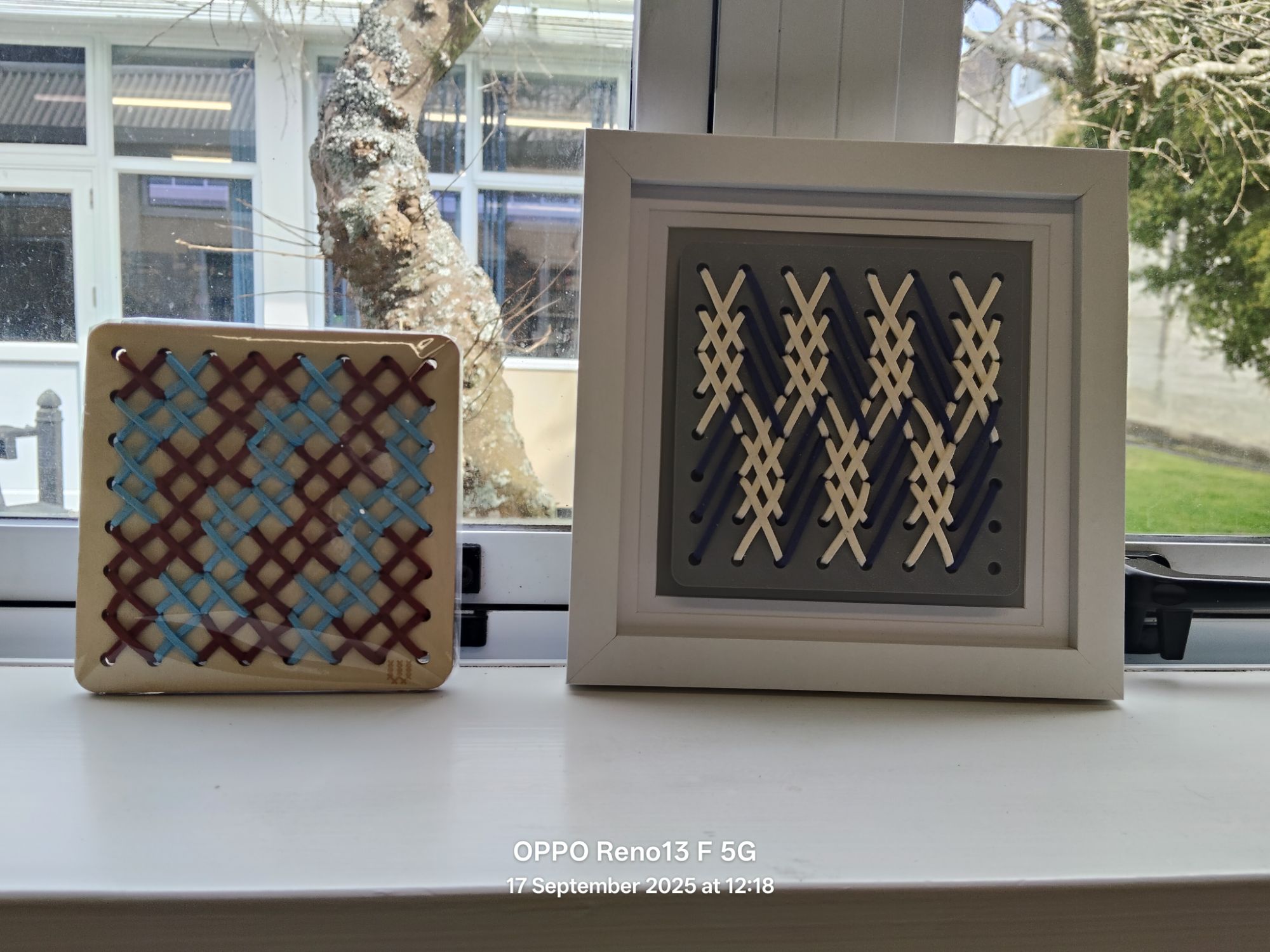
Weaving Patterns were given to me as gifts for my teaching for eighteen years to the public community. Gifts from the ACE.

He mihi nui ki a koe e Stephanie mo te tohutohu me te whakaako i a au mo te ao Maori, tikanga, me Te Reo i a au e ako tonu ana, e tuhi ana, e whakaako ana i nga wa e hiahia ana ahau ki te tangata Maori mai i taku waahi mahi me te Poari Kaitiaki ki a au.

In English – Thank you, Stephanie, for mentoring and teaching me about the Māori world, culture, and Te Reo as I continue to learn, write, and teach when I need a Māori person from my workplace and the Trust board with me.